Last week, I went to the Carnegie Library of Pittsburgh and I found a culinary jewel: “The Art of French Pastry” by Jacquy Pfeiffer, founder of the famous French Pastry School in Chicago. So, I picked this book to do my first ever cookbook review for Inspired Pastry.

As I have mentioned before, I am fairly new to pastry and baking. I only started my formal education about three months ago at the Escoffier School of Culinary Arts.
So far, I have acquired some basic skills like preparing pâte à choux and crème pâtissièr, so I decided to prepare the Salambos, practice these skills and make a first review of “The Art of French Pastry” from a humble student’s perspective.
Salambos are similar to Éclairs. Both are made with choux pastry and filled with pastry cream. However, Salambos are shorter and oval-shaped, and they are covered with caramel.
These are the ingredients according to the book. But, I only prepared half because I did not want to eat 4.5 dozens of 1.5 in. Salambos (the yield of this recipe).
Ingredients and Mise-en-Place for the Pastry Cream:
 1 Pâte à choux
375 g Whole milk
37.5 g Butter, 82% fat
45 g Granulated sugar
0.75 g Vanilla bean
15 g Cornstarch
15 g Cake flour
45 g Granulated sugar
90 g Egg yolks
1 Caramel recipe
50 g Sliced almonds
As you can see, the recipe makes a reference to 2 additional recipes: choux pastry and caramel. The rest of the ingredients are used to cook a pastry cream for the filling. So, let’s start by doing a pâte à choux.
Since I did not want to write a super long post, I divided this review into 2 posts. For more on how to prepare the Pâte à Choux, click here.
Once I had my choux pastry ready to go, I prepared the pastry cream. But, before I continue, let me tell you that there is a huge difference between using vanilla extract and vanilla bean. If you think that vanilla extract is expensive, wait until you pay $6 for 2 vanilla beans. But, I must say that it is worth every penny. Adding vanilla extract to hot pastry cream is very aromatic, but adding vanilla bean is amazing. I could smell vanilla bean on the other side of my apartment even about half an hour after finishing the pastry cream.
 1.Preheat the oven to 400 F. I lined my baking sheets with silicone mats instead of parchment paper. pipe 1 1/2 in. ovals on the baking sheets, brush egg wash, draw straight lines along each Salambo using a fork to ensure even raising, and bake for 10 minutes at 400 F. After 15 minutes, lower the temperature to 325 F and bake for 45 minutes until the Salambos are brown. They should be hard and they should sound shallow if you knock on the top. When done, do not turn off the oven. Lower the temperature to 300 F so we can toast the almonds later. “The Art of French Pastry” has a very thorough description about piping techniques that was really helpful to pipe the Salambos.
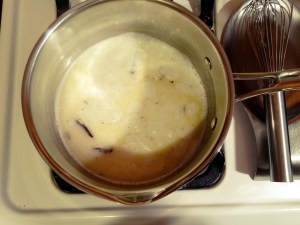 2. Mix the milk, butter, sugar, vanilla seeds and vanilla pod in a saucepan. Turn on the heat to medium and stir with a whisk. I opened the vanilla bean by cutting it on the long side using a pairing knife. I took out the seeds, but I added the pod and the seeds to the milk mixture.
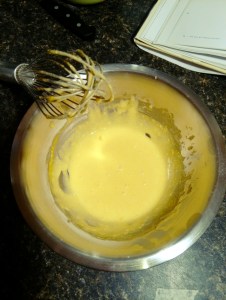 3. At this point, Chef Jacquy Pfeiffer uses another mixing bowl to whisk together the cornstarch, flour, sugar and eggs, while we bring the saucepan mixture to a boil. However, I usually bring the mixture to a boil first, and then I whisk the eggs, sugar and the rest of the ingredients to prevent the eggs from absorbing the sugar and changing the cream’s consistency.
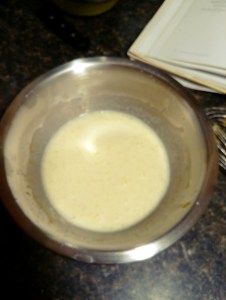 4. Remove the the vanilla pod from the boiling mixture and temper it into the eggs mixture. Tempering means that we will carefully pour half of the saucepan’s content into the eggs mixture while we whisk without stopping. Then, pour the tempered mixture int he mixing bowl back into the saucepan.
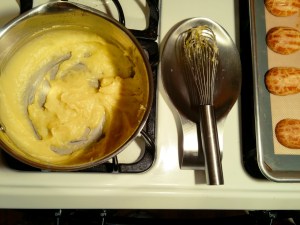 5. Turn the heat to medium and whisk everywhere. I make a large circle and then a figure eight and keep repeating these steps so the mixture would not scorch.The pastry cream will start thickening in a very sudden way. As soon as this happens, remove it from the heat and whisk for 30 seconds until it completes the thickening process and it looks uniform. Chef Jacquy Pfeiffer mentions that this would allow the eggs to coagulate slowly and evenly, resulting in a creamy pastry cream. Return the pastry cream to medium heat, bring to a boil and whisk constantly to finish cooking.
 6. As soon as the starchy flavor is gone, transfer the pastry cream to a baking sheet, expand it and cover it with plastic wrap. Let it cool and freeze for 15 minutes. Covering the pastry cream prevents it from forming a dry skin and freezing it stops bacteria from forming.
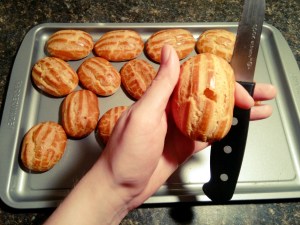 7. Using the tip of a pairing knife, cut out a small hole on top of each Salambo, right on the center.
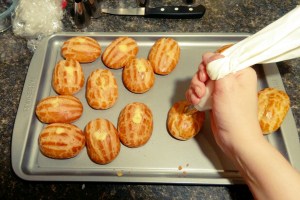 8. Take out the pastry cream and if it’s necessary, whisk it and put it in a pastry bag fitted with a 3/8 in. round tip. Fill in each Salambo through the open hole until the pastry cream starts to ooze out.
9. Put the almonds on a baking sheet and bake for 15 to 20 minutes until golden.
10. I prepared caramel dissolving sugar in water and heating it until it reached 325 F. I did not take any pictures of this step because I feared that multitasking could cause me a sugar burn.
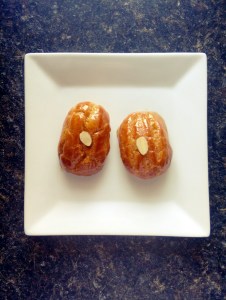 11. I submerged the Salambos’ tops into the hot caramel and cleaned it off on the saucepan’s border. Then, I placed a sliced almond on top of the Salambo to cover the hole. Let the Salambos cool and enjoy!
To summarize, I think that “The Art of French Pastry” is a great book for actually learning advanced techniques. This book is a true learning tool that enables the student to attend a lesson with Chef Jacquy Pfeiffer from your own kitchen.
I’ll be making more recipes from this book and others, and share my learning experience with you. So, if you have any suggestions for the next recipe please let me know in the comments.
 Inspired Pastry