Pâte à Choux is one of my favorite preparations because of its versatility and rich flavor. You need Choux Pastry to do Profiteroles and Eclairs, two of my favorite French desserts. And things get even better if I tell you that you can also prepare Churros, one of most famous Spanish-Mexican desserts just by frying the choux pastry instead of baking it.
In this post, I will follow Chef Jacquy Pfeiffer’s approach to Pâte à Choux that can be found in the “The Art of French Pastry”. This post complements a previous post in which I prepared Chef Jacquy Pfeiffer’s Salambos. Hint: They were deliciuos!
Ingredients for the choux pastry and mise-en-place:
 125 g Whole milk
125 g Water
110 g Butter (82% fat)
5 g Granulated sugar
2 g Sea salt
140 g AP flour, sifted
220 g Whole eggs
1 Egg wash
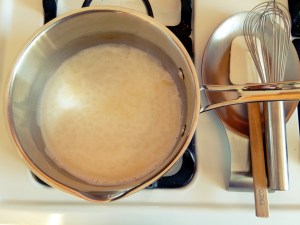 1. Mix the milk, water, butter, sugar and salt in a saucepan. Bring to a boil, check that the ingredients are well incorporated and turn off the heat. The mix should have a uniform texture and color. Having some white foam on the sides is OK, but seeing small butter pieces is not OK. Chef Jacquy Pfeiffer advises to use a whisk rather than a spatula to avoid lumps. I definitely agree with him. A whisk is a great tool to get a uniform and smooth choux pastry.
 2. Add the sifted flour to the saucepan and whisk vigorously until the four is evenly incorporated. I never time for how long do I mix, but Chef Jacquy Pfeiffer advises to whisk for 30 seconds. Surprisingly, you don’t need more than that. As soon as you finish counting to 30 the flour will be perfectly incorporated.
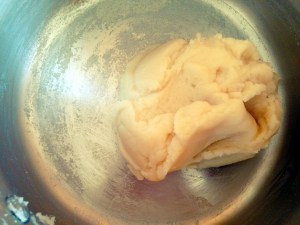 3. Turn the heat on to medium and stir with a spatula to cook the choux pastry for 1 minute until it is dry and it begins to stick. Slightly before 60 seconds the choux pastry starts making a hissing sound and sticking to the saucepan.
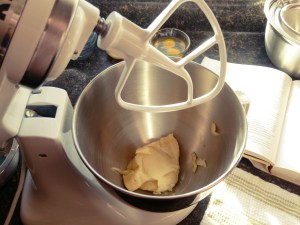 4. Transfer the choux pastry to the stand mixer fitted with a paddle attachment, and mix for 30 seconds on medium speed. What Chef Jacquy Pfeiffer did not mention is that we mix the choux pastry alone because it has to cool down before adding the eggs or we will end up with scrambled eggs around the choux pastry. The mixture has to be between 110 F and 140 F. I always use a thermometer to measure the temperature just to make sure.
 5. Add the eggs one by one turning down the speed every time you add an egg to avoid any unpleasant splashes. Then, increase the speed to medium and check that the egg is well incorporated before adding the next one. I also scrape the bowl with a spatula between each egg to make sure that we don’t leave unbeaten dough on the sides.
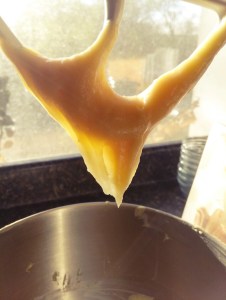 6. Check for consistency. This part is very cool because instead of putting a little bit of choux pastry between your fingers and checking its elasticity, you can just drop the paddle attachment to the bottom of the mixing bowl and pull it up. If the dough forms a steady V-shape, we reached the right consistency. If we do not get the right consistency, Chef Jacquy Pfeiffer provides some troubleshooting tips. We can add just a little bit of warm milk or eggs. But, we have to be careful. Do not add too much liquid or the choux pastry will be ruined.
 7. Once the choux pastry achieved the right consistency we can put it in a pastry bag fitted with a 3/8 in. round tip. Then, we can pipe the dough depending on the pastry we are preparing.
8. For more choux pastries, take a look at my Salambos or check out Chef Jacquy Pfeiffer’s book: “The Art of French Pastry” .
 Inspired Pastry